Picture of the Week 34 – Mushrooms in the Rain

Canon EOS 60D ,Canon EF-S 18-55mm f/3.5-5.6 IS
1/125s f/16.0 at 30.0mm iso800

Just because the weather is “bad” doesn’t mean that you can’t take good photos.

A few day ago I was walking to work, and to my surprise it was drizzling. Most people might immediately give up any thoughts of taking photos under such conditions. However, I was soon drawn to these mushrooms, realized that my camera battery was empty, and ended up going back home to make sure I wouldn’t miss the shot.

I love the patterns of water drops on the mushrooms. Rain drops, or morning dew, also works really well with flowers. So, the next time you think the weather isn’t good enough for photos, think again, and see if you can find some creative ways of taking advantage of it.

Posted in Picture of the Week | Leave a comment

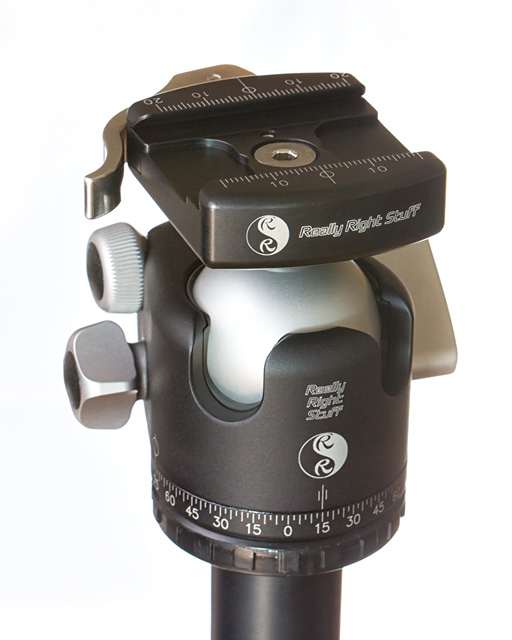
Picture of the Week 33 – Product Photography: Really Right Stuff Ballhead

Canon EOS 60D, Canon EF 70-200mm f/2.8L IS USM
with Canon 500D close-up lens
0.80s f/16.0 at 70.0mm iso800

Want to try something hard? How about product photography?

Yes, product photography is hard. You might not think so until you’ve tried it yourself. I dabble in it once in a while, but I don’t do it on a routine basis.

I wanted to show you my new BH-40 ballhead from Really Right Stuff. I’ll talk it about it a bit more in the near future when I’ll do a post on tripods (the short answer: I love it). However, here I’ll rather explain a bit how I took this picture.

Some of the challenges in product photography include background, lighting, the need for attention to detail, and depth of field, especially for small products. Unless you show a product in context (say a car on a road), you usually want the background to be neutral, e.g. completely white. Lighting should be even (no dark or harsh shadows), and at the same time a few highlights can give that extra shiny or sparkly look. You can buy a fancy kit (something like this or this), or you can improvise like I show below.

Attention to detail is important. Are you showing all the features of the product (e.g., all the knobs and handles in this case)? Is the object really clean and free of scratches? You wouldn’t believe how much a tiny speck of dust will show on a macro of a small product. Of course you can retouch it to some extent, but the cleaner you start, you less work you’ll have in post-processing.

Another challenge is depth of field. It depends on the product, but you often want the whole thing in sharp focus. If the product is small, and you’re using a macro lens or otherwise shoot it at a really small distance, getting enough depth of field can be quite hard. See what you get with f/16 for starters. With even smaller apertures (larger f-stop numbers like f/22) you tend to lose sharpness due to diffraction. If you’re not getting enough depth of field, you’d have to stack multiple photos where the focus was set to different distances.

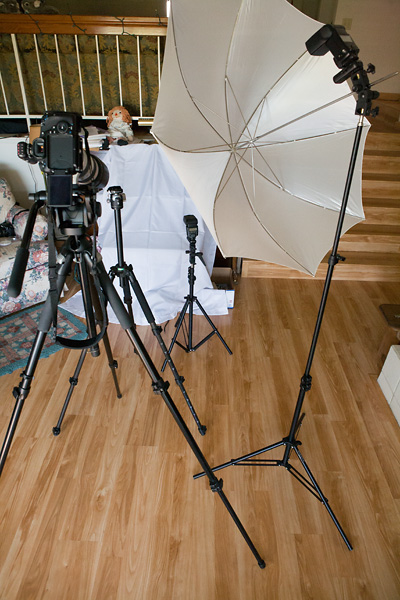
So, how did I take the photo above? Here’s the setup:

From left to right: camera on tripod, the ballhead on another tripod, a white background cloth (draped over a piano bench), a wirelessly triggered flash on a light stand to light up the background, and another wirelessly triggered flash shooting through an umbrella for a main light.

There was also some light coming in through a large window behind me, and the final exposure was a mix of natural window light and flash light. The main light actually ended up on the other side (to our left rather than the right), but this was the cleaner shot of the setup with far less unrelated clutter showing.

Posted in Photographic Equipment, Picture of the Week | Tagged , , , , | 1 Comment

Picture of the Week 32 – Geese at Lake Murray

Canon EOS 60D ,Canon EF 70-200mm f/2.8L IS USM
1/1250s f/6.3 at 200.0mm iso200

Yesterday we went for a walk around Lake Murray. We walked from about 9:30 to 11:30 in the morning, and while it was quite hot, it was still an enjoyable walk. Of the various shots I got (lake shore grass, fishing boats, etc.) family council voted for the geese as the picture of the week. 🙂

Two topics come to mind when I think about this image: “bad” light and cropping.

Light: Yes, all photographers know that the best light is usually early in the morning (just before and after sunrise) and in the evening (just before and after sunset). However, that does not mean that you can’t take good photos during the middle of the day. I didn’t do a whole lot to this photo to enhance it, other than to add a little bit of a warm glow effect.

Cropping: Depending on your camera, the photos you take are probably in a 3×2 format (SLRs) or in a 4×3 format (compact cameras), but you don’t always have to keep that aspect ratio. The high megapixel count of almost all digital cameras these days means that you have plenty of room to crop, and still end up with a high resolution image.

In this image, the line of geese begged for a more elongated format, so I cropped it to a 16×9 ratio (which is incidentally the ratio of widescreen TVs and many computer monitors). I wanted a little space in front of the geese (i.e., at the right edge of the photo) into which the geese can walk in the viewer’s mind. However, I didn’t want more “negative” space above or below the geese.

So, the next time you look at an image of yours that doesn’t seem to quite match the default format of your cameras photos, try experimenting with different aspect ratios.

Posted in Picture of the Week | Tagged , , , , , , | 3 Comments

Picture of the Week 31 – La Valencia Hotel

Canon EOS 60D ,Canon EF 70-200mm f/2.8L IS USM
1/1000s f/8.0 at 70.0mm iso400

This is the famous La Valencia hotel in La Jolla.

I might use this picture to talk about composition (I like how the hotel is framed by the palm trees), the use of a polarizing filter (which helped darken the sky), or catching the right moment (doesn’t the seagull add a nice touch?). However, I’ll use it instead to talk about a much neglected piece of equipment:

The tripod.

A tripod is perhaps often considered a hassle. You have to carry it around in addition to your camera(s) and lens(es), and you have to take the time to set it up before taking a shot. So, why bother?

Tripods have many benefits. They help produce sharper images than handheld shots by providing stable support. In this image, at 1/1000s, with an image stabilized lens, that benefit is probably fairly minor. However, I still benefited from using a tripod in at least three different ways in this photo:

  1. It caused me to slow down and visualize the image before deciding whether it was worth taking.
  2. It enabled me to carefully compose my image.
  3. It allowed me to wait patiently for the right moment (seagull in the right spot) while exactly preserving the composition and avoiding fatigued arms.

How do you pick the right tripod? That’s a long story; I’ll save it for another post. However, almost any tripod is better than no tripod, so if you already have one, try using it more often. It will almost certainly help you shoot better photos.

Posted in Picture of the Week | Tagged , , , , , | 1 Comment

Kiboko 22L+: The Best Photo Backpack Ever Made?

This slideshow requires JavaScript.

The quest for the “perfect” camera bag is a struggle that many photographers can undoubtedly relate to. Is anything ever perfect? Of course not, almost everything in life is a compromise. However, let me give you my impressions of what might well be the best photo backpack ever made: The Kiboko 22L+ from Gura Gear.

The company was founded a few years ago by wildlife photographer Andy Biggs. The first bag they created was the Kiboko 30L (or just “Kiboko” at the time). It was designed to be the largest bag that would comply with airline carry-on requirements to hold a maximum amount of gear, and yet be as light and comfortable as possible.

A few years later, they added the 22L+ as the smaller brother of the original backpack. The “L”, by the way, stands for liters, denoting the usable volume of the bag. (They also have the “Chobe”, a multi purpose shoulder bag.)

Both Kibokos share some design features that distinguish them from other backpacks. They are made from super light yet strong materials such as sail cloth and weigh only about 4 pounds. They have a fully functioning harness so that you can carry a full pack with minimum discomfort. They also have a unique butterfly flap design that allows accessing half of the bag’s content at a time as you will see in the slideshow above.

While the 22L+ is smaller than the original 30L, and hence does not fit some super tele lenses, it does have a laptop compartment (against the back), which the 30L does not have. Because that compartment takes up some of the depth of the bag, certain large bodies (such as a Canon 1D with an attached L bracket) may not fit comfortably.

I used the 22L+ on a recent two week vacation and was really impressed with the bag. Your needs may vary, but for me the 22L+ is the right bag and the 30L would not be. I don’t have super tele lenses, nor large camera bodies, but I do occasionally want to be able to carry a laptop, such as when I’m between destinations on a road trip, and don’t want to leave valuables in the car.

I was carrying between 25 and 35 pounds of gear for several hours at a time. Sure, I felt the weight, but I never had sore muscles the next day, nor did I have any need for physical therapy. So, I’d say the harness did its job. However, I do agree with Nick Devlin’s quote about whether the bag is big enough, and I chuckle when I read it: In a word, the capacity of the 22L+ is “sufficient”. As in, ‘please God don’t ever let me take more gear than this on a trip with me.’

Ok, if you’re still wondering if the bag is big enough and really need to know: I was carrying a Canon 5D with EF 24-70mm f/2.8L attached, Canon 60D with 70-200mm f/2.8L IS attached, Canon EF 50mm f/1.4, Canon EF 16-35mm f/2.8L II, Sigma 15mm f/2.8 EX DG Fisheye, Canon 430EXII flash, spare batteries and chargers, various filters, flash triggers, cables, and miscellaneous other little things, tripod, 15 inch MacBook Pro, Kindle, several collapsible water bottles, bug spray, and probably some other stuff I’m forgetting now.

Some people who have reviewed the Kibokos have reported that the butterfly design took them some getting used to. I must say I like it. As a side effect, having the usable space split down the middle of the bag allows me to easily store two bodies with lenses attached, which is how I almost always work. Few other backpack seem to be configurable that way.

There are too many well thought out design details of the bags to list them all here. Let me just say that I am thoroughly enjoying the bag and haven’t found any downside yet. I obviously haven’t had the bag long enough to comment on durability, but it seems to be extremely well made from tough materials. Others have used their original Kibokos for several years in the field, and I have yet to read a report of anything failing. I did once accidentally back into a really pointy tree branch that probably would have given me a nasty poke in the back had I not carried the backpack. I can’t even tell where the branch hit the bag.

I said I hadn’t found any downside yet. Once you look up the price tag of $379, you might disagree with me. However, I will claim that you often get what you pay for, and this bag is a great example. Also, almost any one piece of gear (cameras, lenses, etc.) you put inside the bag probably cost you more than the whole bag, so keep that in mind!

Posted in Photographic Equipment | Tagged , , , , | 2 Comments